|
Photo 5 (Return)
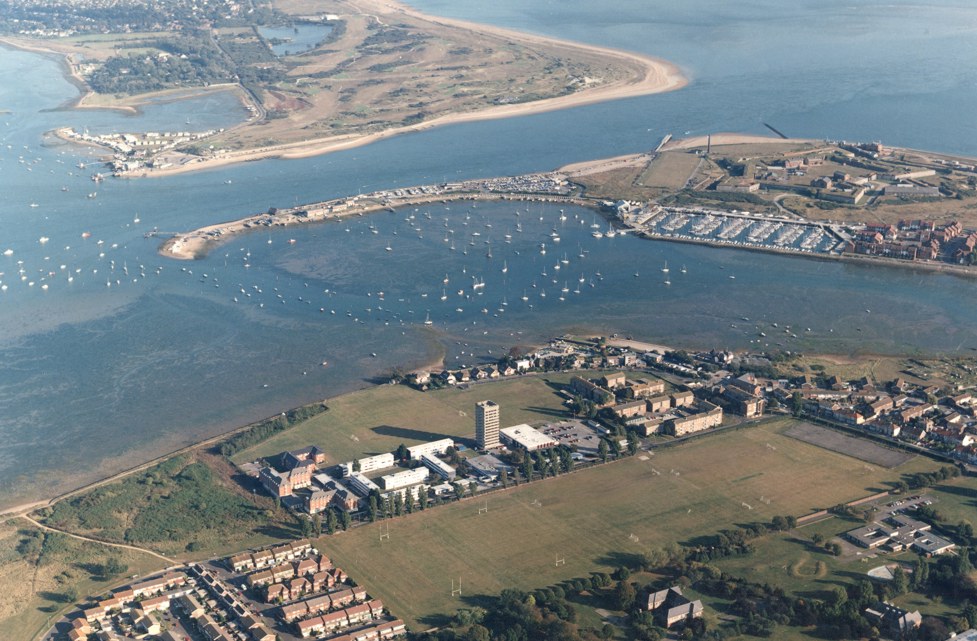
Langstone Harbour inlet, 2001. Shoreline drift converges upon the inlet from the east and west leading to growth of forelands at Gunner Point (1) and Eastney spit (2). Strong currents generated by tidal exchange at the confined estuary inlet flush the majority of arriving sediments seawards resulting in accumulation of a major ebb tidal delta to the south (out of shot to right). Some sediments travel northward (right to left) along the inlet margins to contribute to the recurved spits (3). Specific features are identified as follows:
- Gunner Point and Sinah Warren: a gravel and sand dune foreland that has accreted seaward by over 600m since the 17th century. It comprises approximately the area covered by the golf course, together with a series of gravel ridges and active dunes closer to the shoreline.
- Eastney Spit: a wide gravel and sand feature that appears to have extended eastward (right to left). It is occupied by the 19th century Fort Cumberland.
- Recurved distal points of Eastney Spit and its counterpart on the Hayling shore.
- The Kench: an embayment formed from relic spits that may previously have flanked the harbour inlet. If this interpretation is correct, the inlet may have had a historical tendency to migrate.
- Reclaimed harbour margins dating from 1960s
(Photo: University of Portsmouth).
|